
Clinton C. Gardner: Letters to the Third Millenium
Clinton C. Gardner: Letters to the Third Millenium - An Experiment in East-West Communication
Argo Books, 1 Dec. 1981
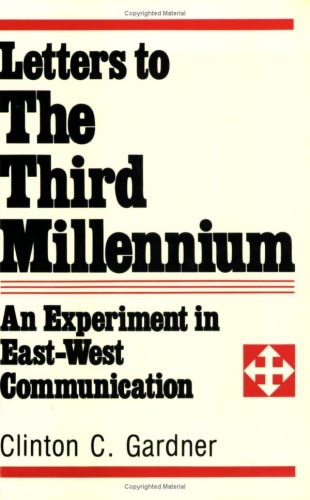
Backside
“A moving, insightful account of a struggle to come to grips with the profound changes that are sweeping our world. … It is addressed to those in search of a vision that can focus their energies and inspire their actions. … A significant contribution to the current literature of cultural analysis and understanding.”
DARROL BRYANT, University of Waterloo, Canada
“Pungently written by a man whose feet are on the ground, yet whose spirit ranges to the ends of the earth, this book belongs in the genre of writers like William Irwin Thompson, Paulo Freire, Charles Reich, and Theodore Roszak.”
THOMAS C. ODEN, Drew University
“Many readers will find it both epochal and apocalyptic - an ‘uncov-ering of the future. … Gardner seeks a new beginning - a way of thought, of speech and of life that will encompass our whole earth in the 2lst century.”
SCOTT FRANCIS BRENNER
“The fact that Gardner has opened up the world of thought of Rosen-stock-Huessy by telling his own story will, I believe, make it accessible and interesting to a rather wide circle of people.”
RICHARD SHAULL, Princeton Theological Seminary
“Deals in an engaging and appropriate way with Rosenstock-Huessy’s thought. … It is my hope that Gardner’s book may be part of a larger renaissance of Rosenstock-Huessy.”
HARVEY G. Cox, Harvard Divinity School
“I enjoyed it, because it threw light on Rosenstock-Huessy.”
MARTIN E. MARTY, Chicago Divinity School
“An impressive achievement. … An interesting and important book.”
PAGE SMITH
“A thoughtful and concerned statement of a businessman who is also a remarkably sensitive observer of history. It deserves an audience both amongst scholars and amongst intelligent citizens of all walks of life.”
FRED BERTHOLD, JR., Dartmouth College
Front and back flap
This is a book about future time: what it is and how we enter it. Contending that today’s “futurists” are not really talking about progress into future time but only about progress on the front of outward space, Clinton Gardner seeks here to articulate a “new language” that will help us enter the future. The key to such a language - which would go beyond the objectivity of science or the subjectivity of religion - the author finds in the work of a remarkable but relatively unknown social philosopher, Eugen Rosenstock-Huessy. The “new thinking” advocated by Rosenstock-Huessy and his friend Franz Rosenzweig is here envisioned as one day taking the form of a new discipline, “a higher social science” that could serve us in the next millennium as natural science and earlier theology have served us in the millennium just past.
Written as a journal of the 1970s, recording trips to Moscow, Canton, Delhi, and Berlin, this book is both an echo of and a response to Zen and the Art of Motorcycle Maintenance. Like Robert Pirsig, Clinton Gardner writes on two levels. The first level is his own experience of the birth-pangs of today’s global society. The second level is a series of “Chautauquas” concerning how Rosenstock-Huessy’s work points to a post-scientific, post-theological language.
This is also a book about reversing trends: today’s trend toward ideological confrontation between the West and the “godless” communists of Russia; the trend toward nuclear Armageddon; and the trends toward the radical right and religious fundamentalism in the United States. The new transcendence, as presented here, is our ability to overcome such “natural trends in ourselves and in society.
While Rosenstock-Huessy attracted the admiration of diverse leaders of contemporary thought, including Reinhold Niebuhr, Martin Buber, and W. H. Auden, this book is the first to provide a general introduction to his work.
About the author
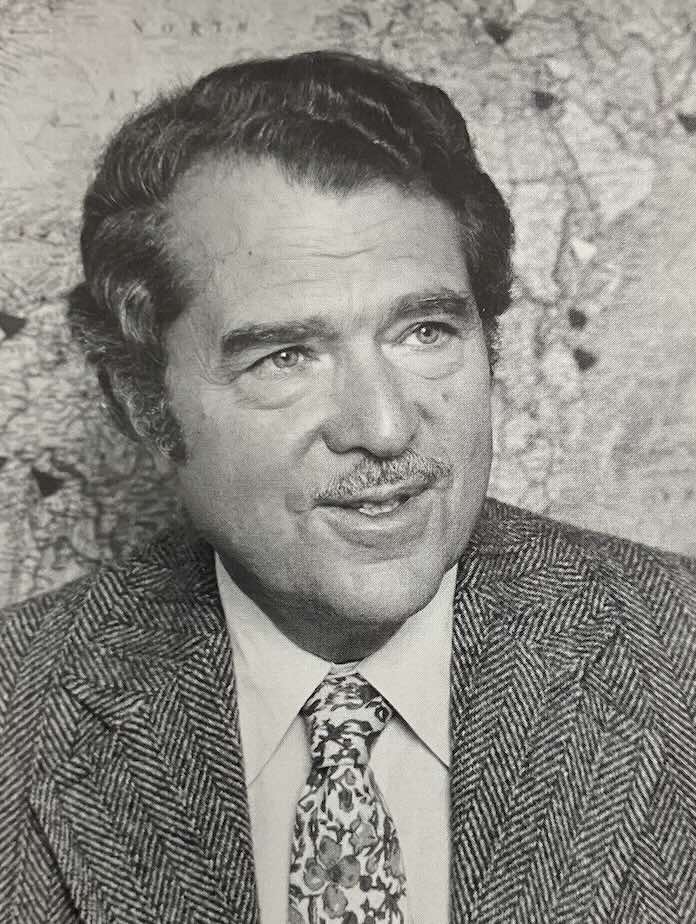
Clinton Gardner is President of The Norwich Center in Norwich, Vermont, an organization which serves as a resource center for a variety of volunteer organizations working on peace-oriented projects. After graduating from Phillips Exeter Academy and Dartmouth College (where he was class of 1944), he did graduate work at the University of Paris in the field of Russian civilization. Since the 1960s he has been engaged in editing and publishing the works of the social philosopher Eugen Rosenstock-Huessy, about whom he has also lectured in the United States and Europe.
During World War II Mr. Gardner was an artillery officer who landed in Normandy on D-Day. He was twice awarded the Purple Heart for wounds received in action. Later he was Executive Officer of the military government team that took charge of the Buchenwald Concentration Camp upon its liberation. In Berlin during the “airlift” period of 1948-49 he was Managing Editor of Die Neue Zeitung, the newspaper published for the German public by American military government.
In 1956 Mr. Gardner and his wife Elizabeth founded Shopping International, a mail order and importing company specializing in handicrafts, which they continued to manage until 1979. They now operate a consulting and wholesale company, Craft Sources, which concentrates on handicrafts from the Third World.
Contents
- Preface: In Search of a New Language
PART I: The Unity of Times
- 1 Planetary Consciousness (Guadalajara)
- Tribal Consciousness
- Religious Consciousness
- Scientific Consciousness
- Planetary Consciousness
- 2 The Gregorian Millennium (Paris)
- The Papal Revolution
- The Reformation
- The Parliamentary Revolution
- The French Revolution
- The Russian Revolution
- The Planetary Revolution
PART II: A New Discipline
- Transition: At the Karouiine Mosque (Fez)
- 3 Four-Dimensional Man (Kyoto)
- How Speech Creates Reality (Ramat Hadar, Israel)
- Our Four Dimensions (Boone, North Carolina)
- Our First Dimension: Man’s Vast Future
- The Second Dimension: Our Inner Self
- Our Third Dimension: Past Time
- Our Fourth Dimension: The Outer World
- All Four Dimensions: Our Soul
- 4 The Cross of Reality (Berlin)
- Respondeo etsi Mutabor
- The Time and Space Axes
- Kairos or Super-time
- At Reality’s Center
- 5 The Metanomics of Society (Delhi)
- A Dialogue with Phaedrus
- Meta-nomics vs. Meta-physics and Theo-logy
- The Model of Four
- A Non-Freudian Psychology
- A Higher Sociology
- The Anti-Mechanist Revolt
- The a priori of Peace
- History’s Metanomical Axioms
- Literary Dessert Forks
- The First “Modern” Scientist
- Teilhard de Chardin’s Cross of Reality
- The End of Philosophy
- The Task of a Future Science
- PART III: Bridging the East-West Gap
- 6 The Mystery of Social Life (Moscow)
- Ludwig Feuerbach
- The Trinity and the Cross of Reality Panentheism (Norwich)
- The New Transcendence Barth, Bonhoeffer, and Molte The New Covenant Vision
- 7 Liberation and Change (Princeton)
- Fanshen (Canton)
- Building the Global Village (Norwich)
- 8 A Metanomical Pedagogy (Haarlem)
- Camp William James
- Planetary Service
- Aquarians or Argonauts (Norwich)
- 9 A Letter to Moscow
- Notes
- Biography of Eugen Rosenstock-Huessy
- Selected Bibliography
- Name and Title Index
- Subject Index